
Small experiments in attention, movement, and stillness for ordinary days.

The Neural Compass — a small light of attention in a wide, noisy world.*
The moment before the next notification
The phone lights up. A thought starts rehearsing tomorrow’s meeting. You keep listening to a friend while part of your mind prepares what to say next.
Most days, attention is already on its way somewhere else.
Meditation is often pictured as a special event: a quiet room, a fixed posture, a mind emptied of thought. But attention can also begin in an ordinary moment—a foot meeting the pavement, a sound fading, or the pause before replying to a difficult message.
The twelve practices below take inspiration from themes associated with Osho’s The Book of Secrets, a collection described by its publisher as exploring 112 awareness techniques. They are contemporary adaptations, not a definitive account of the book or claims that every exercise appears there under these names. The original draft’s quotations are omitted because their wording and attribution have not been verified.
Treat each practice as a small experiment, not a promise of instant calm or transformation. You may feel more settled, no different, or even uncomfortable. You can adapt an exercise, skip it, or stop.
A 45-second arrival
Before continuing, let your eyes rest on an ordinary object. Notice one sound and one point of contact between your body and the chair, floor, or clothing. Ask yourself: What has my attention right now?
Don’t try to change the answer. Just notice it. That is the whole exercise.
A map, not a ladder
The twelve practices fit into four loose groups. Choose whichever feels workable today; there is no order to complete.
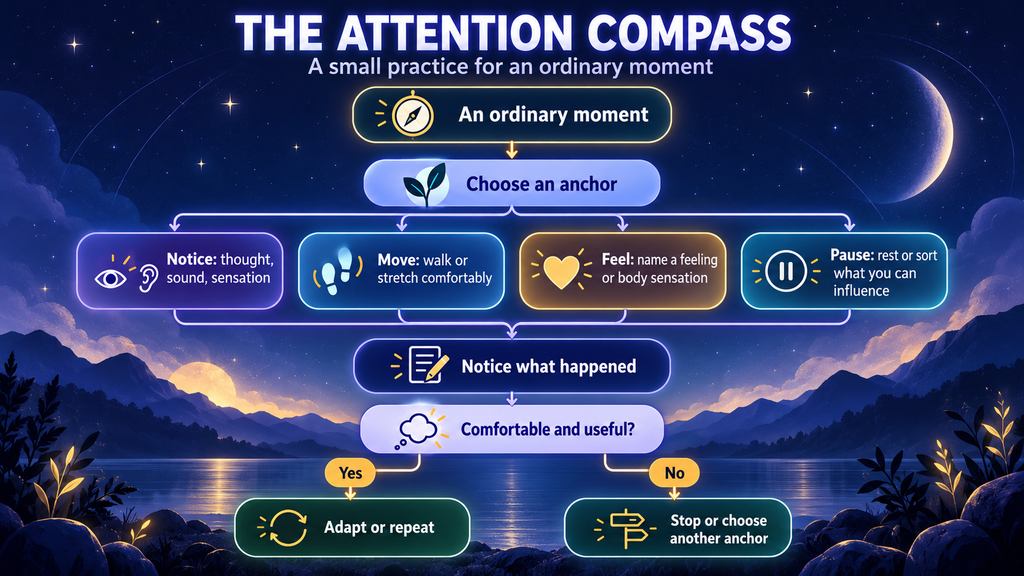
This is a menu, not a path you have to finish.
1. The observer pause
Notice a thought without treating it as an instruction.
When “I have to reply now” or “I’m doing this wrong” appears, quietly label it planning, judging, or simply thought. See whether it fades, grows, or leads to another thought. When attention gets carried away, return gently.
Try this while waiting or before answering a message that has stirred you. In a conversation, keep listening; the pause is not a reason to withdraw from the other person.
2. A playful smile
Meet seriousness with curiosity, not pressure to feel cheerful.
In a low-stakes moment, notice your expression and inner commentary. Ask, “What is my mind treating as extremely serious right now?” If it feels natural, soften your face or smile at the mind’s dramatic narration. If it feels false, skip the smile.
Playfulness should never be used to dismiss real pain—yours or anyone else’s.
3. Walking attention
Let the sensations of walking be your anchor.
On a safe stretch of ground, keep your eyes open and notice one foot touching down, then the other. Feel the shift of weight or the movement of your arms. When thoughts pull you into a plan or a replay, return to one sensation of walking.
Move at a pace that suits you. Stay alert to traffic, people, and obstacles; safety comes first.
4. A gentle reflection on change
Remember that life changes, then ask what matters today.
Think of an ordinary thing that has changed over time: a routine, a friendship, a place, or a skill you learned. Notice what comes up. Then ask, “What is one small action I genuinely want to take today?”
It might be sending a kind message, resting, or setting a boundary. This is not a prompt for a dramatic decision. Skip it if reflection on mortality or change feels overwhelming.
5. Embodied awareness
Notice the body with respect for comfort and boundaries.
Fully clothed and on your own, notice broad areas of the body: feet, legs, hands, shoulders, face. Which sensations feel neutral, pleasant, tense, or hard to sense? Stay with what feels manageable; you don’t need to investigate discomfort.
This exercise is not sexual or therapeutic. If practicing with a partner, make consent explicit and keep stopping easy. The body-awareness exercise is a modern adaptation, not a claim about a specific passage in Osho’s book.
6. Listening to thought and sound
Let thoughts be present while returning to one sound.
Choose a sound—a fan, birds, distant voices, or traffic. Notice its pitch, rhythm, or distance. If a thought takes over, label it remembering or worrying, then return to listening. If sound is uncomfortable, choose a visual object or the feeling of your hands instead.
There is no score for having fewer thoughts.
7. Two minutes without a task
Pause without requiring the pause to improve you.
Sit, stand, or lie down for two minutes. Notice sounds, sensations, thoughts, or the urge to get up. If your mind says, “This is pointless,” notice that judgment too. Let the timer end the exercise.
If stillness feels uncomfortable, shorten the pause or look out a window. Rest is not a test, and important responsibilities still deserve attention.
8. Meeting anger without handing it the steering wheel
Acknowledge the feeling and choose what happens next.
If you can, step away from the situation until you can respond safely. Name what you notice: “I’m angry,” or “Something feels heated.” Ask, “What do I know happened? What am I interpreting? What response would be responsible?”
You might pause the conversation, state a boundary, or ask for clarification. Observing anger does not excuse harm, and meditation is not a substitute for getting to safety when someone may be in danger.
9. A wish for well-being
Practice goodwill without forcing affection or reconciliation.
Think of someone you feel safe wishing well. Silently offer a simple wish: “May you be safe,” or “May your day contain some ease.” If it feels comfortable, offer the same wish to yourself, or to someone neutral you encounter.
You do not need to include a person who has hurt you. A wish does not replace boundaries, accountability, or an honest conversation. This exercise resembles loving-kindness practices from traditions beyond Osho’s work; it is included as a modern adaptation.
10. The uncertainty pause
Separate what you can influence from what you can’t know yet.
Name one current concern. Divide it into two parts: I can influence and I can’t control. The first might include asking a question, preparing, or requesting help. The second might include another person’s choice or an outcome that has not happened.
Choose one reasonable action—or decide to wait for more information. This is not a reason to accept avoidable harm or skip professional advice when you need it.
11. Comfortable movement
Explore movement without performing for anyone.
In a safe space, try a small movement: shift your weight, roll your shoulders gently, or move your hands. Notice whether it feels comfortable, tiring, energizing, or awkward. Continue only if you want to. Music is optional.
You don’t need to dance, close your eyes, or make a dramatic gesture. Stop if movement hurts, and adapt to your body’s limits.
12. Gentle expression and grounding
Acknowledge a feeling without forcing a dramatic release.
In a private, steady moment, ask, “What am I noticing?” If a word comes—sad, tired, tense, frustrated—let it be enough. If it feels safe, write a few lines, say one sentence aloud, or sit quietly while noticing the room around you.
You don’t have to cry, shout, shake, or uncover a memory. Stop if you feel overwhelmed. This is not a treatment for trauma, anxiety, or depression; persistent distress deserves appropriate support.
The Ethical Lab: a seven-day attention experiment
Keep the commitment small. Try one brief practice each day, or repeat whichever feels most workable.
- Day 1 — Notice: Name what has your attention without trying to change it.
- Day 2 — Walk: Feel your feet meet the ground during a safe walk.
- Day 3 — Listen: Give one ordinary sound a minute of attention.
- Day 4 — Rest: Take a short pause without turning it into a productivity goal.
- Day 5 — Feel: Name an emotion, then consider a responsible next step.
- Day 6 — Wish well: Offer a simple wish for safety or ease to someone you choose.
- Day 7 — Review: Ask what felt easy, awkward, useful, or not for you.
This is a personal experiment, not a clinical study. You don’t need to track your mood or prove that anything changed. Learning that a practice doesn’t suit you is a useful result.
If it doesn’t feel peaceful
A wandering mind is not a failed meditation. Calm is not a required outcome. You might feel bored, restless, unchanged, or unsure. Notice what happened and decide whether you want to continue another time.
If breath or body awareness feels uncomfortable, shift to an external anchor such as a sound, color, or familiar object. If an exercise brings up intense anxiety, disorientation, or painful memories, stop and orient to the room. Don’t push through distress to prove you can.
Meditation is not a replacement for medical or mental-health care. Research covers different practices and outcomes, and it does not support sweeping promises that a brief exercise will rewire the brain, end anxiety, or guarantee better sleep. NCCIH advises people not to use meditation to postpone conventional care. If distress persists or affects your life, consider speaking with a qualified professional.
The quiet skill of choosing
A practice can begin with a small decision: listen instead of interrupting, feel your feet before checking your phone, or pause before replying to a difficult message. None of these moments needs to be dramatic.
The central experiment is not to defeat thought or become a more impressive version of yourself. It is to meet one moment with a little more attention, then make your next choice with that moment in view.
Choose one of the twelve practices. Give it a few safe minutes. Keep what feels useful; leave what doesn’t. Let attention be a practice, not another performance.
Consciousness Compass
- What has my attention right now?
- Which practice feels workable for my body and circumstances?
- What would it mean to stop or adapt without calling that failure?
- What is one small, responsible action I want to take next?
Source note: This article is inspired by themes associated with Osho’s The Book of Secrets: 112 Ways to Meditation. The exercises are modern adaptations, not verified quotations or a definitive guide to the book. For health information, see the U.S. National Center for Complementary and Integrative Health’s overview of meditation and mindfulness.